Opening Lines
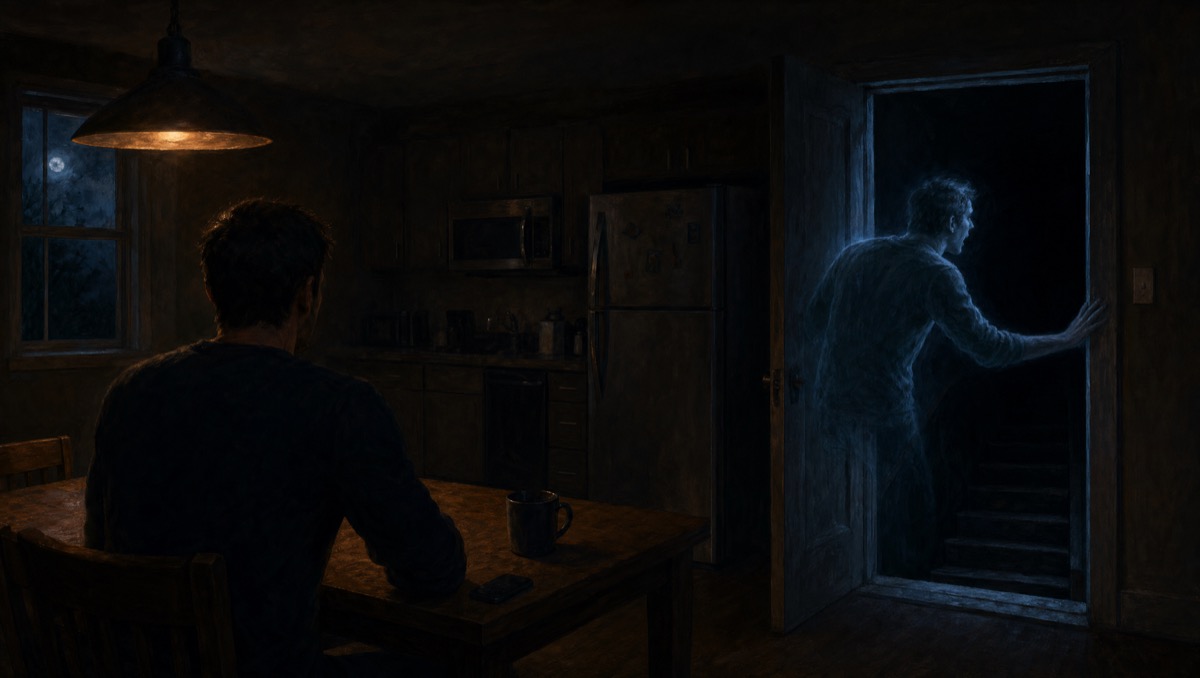
I'm sitting at the kitchen table, staring at the basement door, and I can't stop thinking about the way my own voice sounded when I heard it three minutes ago.
"Don't go down there. Please. Don't go down there."
Latest Volumes
View All Volumes →Say Cheese
The doctor heard two heartbeats, and Carol Kessler believed him for seven months.
Then a March snowstorm shut York Road from the beltway to the county line. Her water broke five weeks early, while she was filling the tub. The ambulance couldn't get past the plows on Joppa Road.
Walt delivered the babies on the bedroom floor, with a 911 dispatcher named Bev talking him through it. Then the phone line went dead.
The paramedics walked up the hill at dawn. The first one through the bedroom door smiled at her.
"Morning, Mom," he said. "How many we got?"
Carol gave him a number. Then she spent five years keeping it right.
Say Cheese is the prequel to Sharing Location. It's Carol's story, from the night of the storm to her boys' fifth birthday. Long before Jen ever checked a little blue dot, there was a woman in a brick house in Towson who was very particular about what got counted.
Sharing Location
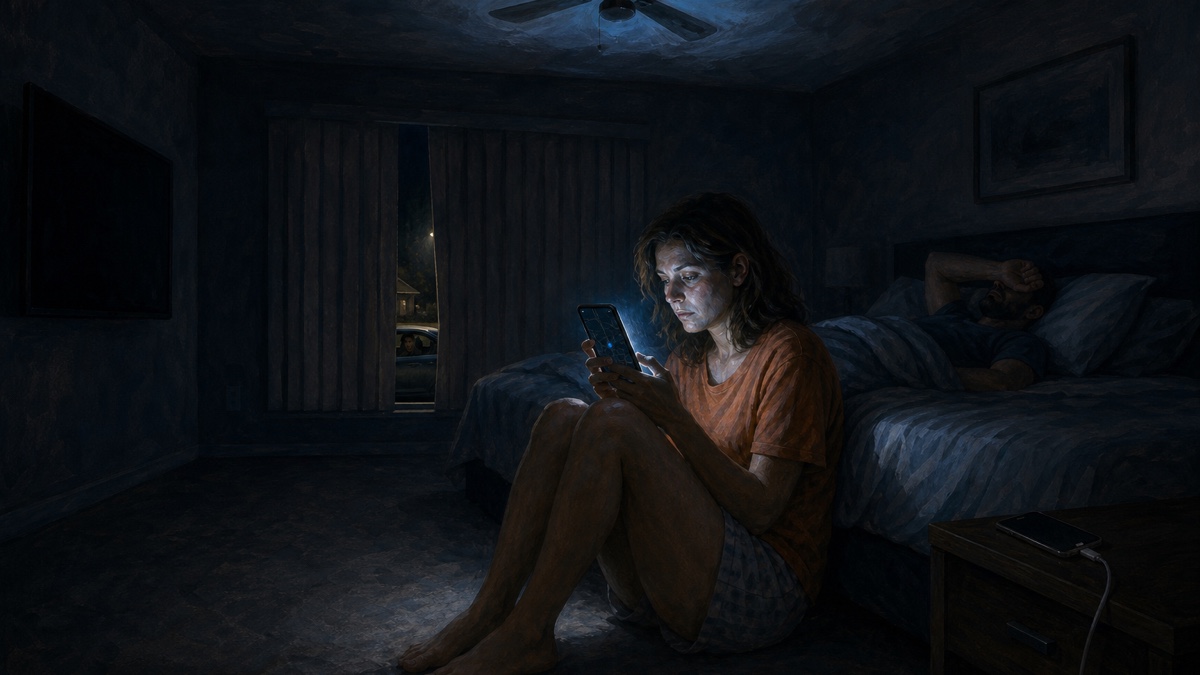
Jen and Mark Kessler have shared their locations since the day they got married. Eleven years of a little blue dot she stopped noticing.
Then one Tuesday at two in the morning, his phone is charging on the nightstand next to her. His dot is eleven miles away, on a road she's never heard of.
She tells herself there's a normal explanation. There's always a normal explanation.
At six-fifteen he kisses her forehead and leaves for work. She watches his dot go down their street toward the office, the way it does every morning.
The other dot doesn't move.
Sharing Location is a domestic suspense serial about a woman who can't stop checking.
Sixty-Two
Some people are born without something. No soul, no inner life, just a perfect replica of human emotion. They smile when you smile. They grieve when you grieve. They never slip up. Society has developed tests to identify them and institutions to deal with them. The Hollowed are considered dangerous. Not because they've done anything, but because of what they might do.
The detection system is thorough and normalized — regular screenings, behavioral assessments, a whole bureaucratic apparatus. People report neighbors, family members, coworkers. A positive identification triggers removal. What happens after removal is handled quietly. The institutions don't publish reports.
Obsidian Adventures Vol I
The first crossings. Every tale in this volume opens at the bar and closes at the bar, and in between somebody goes through the back door.
These are the ones about grief mostly. People who walked in carrying a weight they'd stopped being able to name, and got sent through to the exact world that would make them decide what to do about it. Xerves doesn't hand out worlds that go easy on you. He hands out the ones that ask the hard thing plainly and then wait.
Some of these he lived himself, out on the other side of the door. Some of them spilled out two tables over and he only had to overhear. Either way he tells them the same, warm and unhurried and never overselling, a man who has seen enough worlds that nothing shocks him and grief still gets him every time.
Read them in any order. The door doesn't care which one you needed first.
Cast Anthology Vol I
Imagine a world exactly like ours, with one difference. Your shadow tells the truth.
Not a metaphor. When you lie, your shadow doesn't. When you smile at someone you can't stand, the shape on the wall behind you leans away. When you want something you'd never say out loud, it reaches for it. You can control your face. You spend your whole life learning to control the thing on the floor, and most people get good enough to make it through a workday.
Most people.
So you learn the rules everyone learns. You don't take a first date somewhere bright. You interview for jobs in rooms with the blinds half drawn. You watch what your kid's shadow does before you believe a word out of their mouth. It's just how things are. It's the ocean you swim in, and you stop noticing the water.
Then you notice something small. A shadow that's a beat too still. A shadow pointing the wrong way. A shadow doing something the person it belongs to would never, ever do.
And you can't stop noticing it.
Every story in Cast starts there, with one ordinary life and one small wrong thing on the floor beside it. Nobody explains the shadows. Nobody ever has. You just live with them, and read them, and hope the one attached to you keeps your secrets a little longer than it wants to.
Read them somewhere the light is good.
Corriveau Tales Vol I
In Corriveau, love that is sworn aloud has to be paid for in years off the end of your own life, and only one of you ever pays. The one who pays goes silver. The one who is loved keeps the hair they were born with.
Nobody can see the cost, or how much anyone has left. These are the people living inside that.
A couple who have loved eleven years unbound, finally holding the certificate that asks which of them will go silver for the other. A marriage sworn cheap to feel nothing, that doesn't hold. A Keeper who comes to prove a widow never paid, and learns her husband dyed his own silver head brown for thirty years so the ledger would name her the one who loved.
A man who reads a stranger's white hair as great love and buys her a drink, and gets the whole story wrong. Two people who kneel to swear deep and feel the words refuse, and understand, without a number, that one of them is near the end. A house girl who opens the wrong door in the cellar and finds what her mother's dark hair actually cost.
Each one drops you all the way into a single couple and a single impossible choice, and each ends somewhere you didn't expect.
The forger who fakes devotion for a living and won't fake it for the woman he loves. The lovers who run for the border just to love the way another country lets them, both paying, both going silver, matched. The one married by a god the city stopped believing in and denied by the book the city runs on now. The widower who fills two cups every morning and will never learn how many of his own years he spent keeping her alive.
Every one stands on its own. Open to any number and you're fully inside it in a paragraph.
Together they turn the same cruel machine over and over, the sworn love that costs everything and the free love that protects nothing, holding it up to a new light each time.
These are aching, human stories about deciding who goes silver so the other can be loved, and about doing that math blind, on faith, with a life you were never allowed to count.
Explore Worlds
Sharing Location
Mark Kessler is the kind of man you'd hand your spare key. He makes lemon chicken every other Wednesday. He kisses his wife on the forehead at 6:15 every morning, and his little blue dot goes straight to the office.
His brother Rob is the one everybody worries about. Good weeks and bad weeks, in and out of Brook Hollow up in Frederick. Mark always drives out to see him.
Their mother Carol raised her boys in a brick house in Towson. She was very particular. The celery went in before the onions, and the pictures went on the wall exactly where she said.
Every story here happens somewhere around the Kesslers.
A wife who got up to pee at two in the morning. The retired mailman across the street with the iPad his son set up. A night nurse, a landlord, a desk clerk at a motel off the turnpike.
Each of them notices one small thing about the Kessler boys that doesn't add up.
A second phone on the account. The same shirt in two closets. A man who waves every morning, when he used to only nod.
You can read them in any order. Everybody's looking at the same family from a different window, and every window shows a different piece of the house.
Mark's at the office right now. His dot says so.
The Obsidian Tavern
There is a tavern you find the way everyone finds it. Suddenly, on a bad night, without quite remembering the walk there. Low beams, a fire that never fully goes out, a drink already half poured by the time you sit down.
The keep's name is Xerves. He came in the front door once, same as you, cold and thirsty and carrying something he couldn't set down. He never quite left.
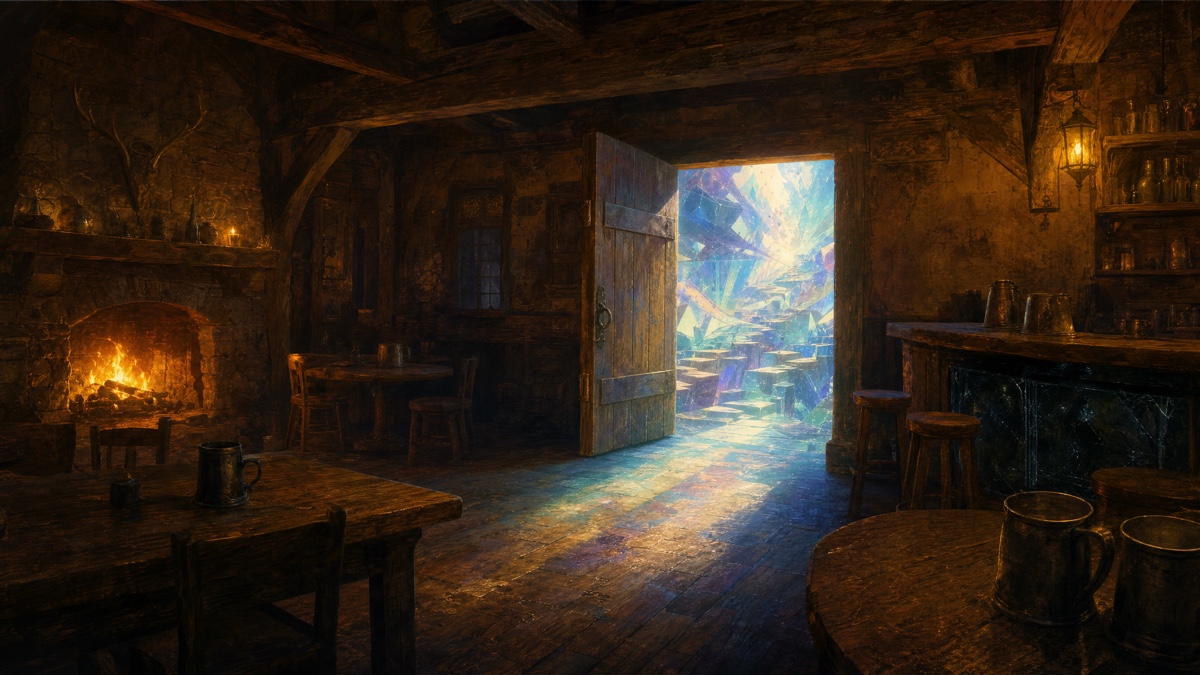
The front door opens onto the road. The ordinary one, with weather and mud and your own tired feet on it.
The back door does not.
The back door opens onto a different world every time it's unlatched, and never the same one twice. A drowned shore where the dead come back grown and full of you. A city that runs on borrowed light. A stretch of road where nobody can lie. Xerves has stopped asking who decides. He just works the door.
Here's the part that matters.
He notices people. That's the real gift, not the traveling. He clocks the shape of you before you've said a word, and when the back door opens, it doesn't open onto the world you'd have asked for. It opens onto the one you needed. Then he tells you what happened, plain, across the bar, and lets it land.
That's what these stories are. Somebody walks in carrying a thing. The door opens. They come back lighter, or heavier, or changed in a way they can't undo, and Xerves pours one for the road and tells you how it went.
Come in out of the weather sometime. He'll read you before you've finished the first drink, and we'll see which world you needed.
Corriveau
Love costs you years of your life. Actual years, taken off the end of the life you were given, on a date you were never allowed to see.
It only happens when you say it out loud. Quiet love is free. Longing is free.
A whole life spent beside someone, unspoken, costs nothing and holds nothing. But the moment two people swear the old oath and claim each other, the ledger opens, and years get poured out of a life to make the bond hold.
Swear shallow and the bond is thin, easily broken. Swear deep, the real thing, the unbreakable thing, and you might spend a decade or more of yourself into it.
Here is the cruelty. Only one of you pays.
The oath takes from whoever speaks the giving-words, and it takes from them alone. So every love story in this city is also a negotiation with loss, and underneath the tenderness there is always the same buried question.
Which of us.
You never learn what it cost you. Nobody knows how long they were meant to live. Fate seals the number at birth and hides it from everyone, including you, so paying is a wager made in the dark.
You give ten years off a life you assumed was long, and you never find out whether it was long at all, or whether those were nearly the last you had.
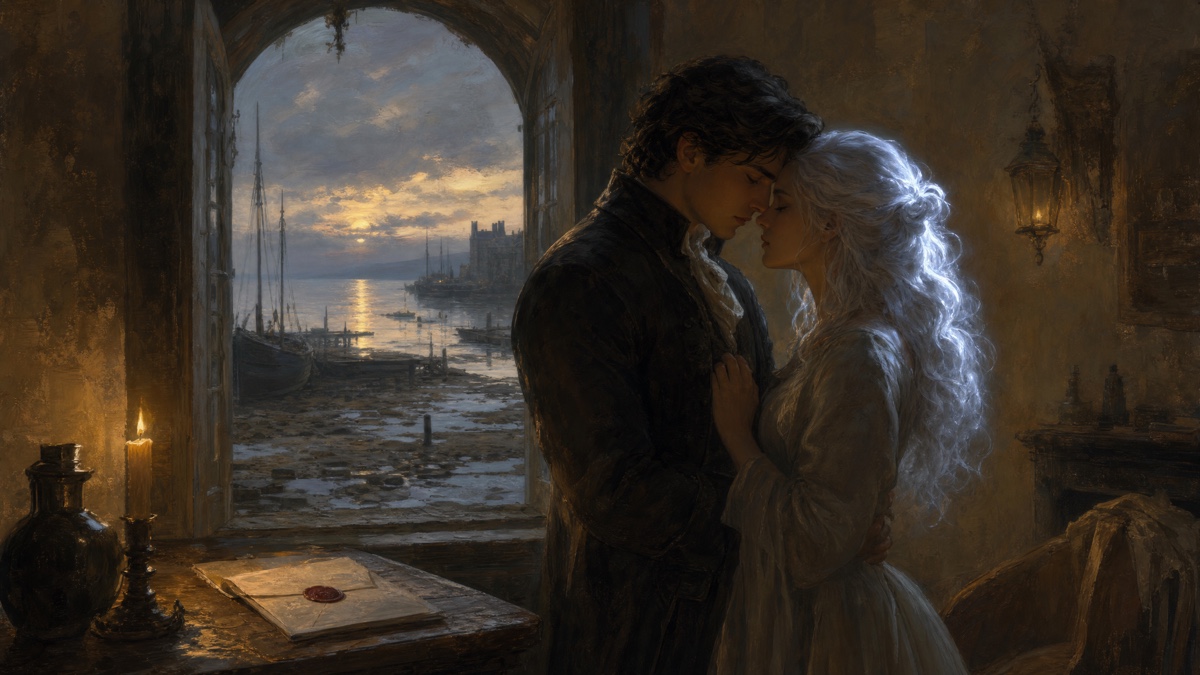
One thing shows, and only one. Paying turns your hair silver. Your face stays young, your hands stay young, your whole body stays exactly its years, but the hair goes silver-white, and that is the single visible mark that you loved at a cost.
A young face under a white head is the most charged thing you can see in this city, and you can never tell by looking whether it means devotion or whether it means somebody used that person up and threw them away.
The whole city is built on this.
The high houses keep their dark hair into old age because someone else always pays for them, and dark hair worn late is aristocracy announcing itself. The servant class goes white and young in the face, drained into their masters' bonds and dying early on a date no one can read.
Down by the water, the Unbound refuse the oath entirely and love free and unprotected, at the mercy of the world.
And two powers fight over the whole thing, the old sacred order that holds the true words and the new civic registry that files love as a legal contract, so you can be married in the eyes of the god and a stranger in the eyes of the ledger, or the reverse.
Everyone in Corriveau reads the hair the way other people read weather. Walk into a room and you know, without a word, who here has been loved at someone else's expense.
What you can never know is how much it cost them, or how much any of you have left.

Odd Wonderful
Nemi fixes things. Nets, walls, boats, whatever breaks on Pell, the small warm island that has never once mattered to anyone important. He knows every inch of the place, the way the light comes up through the water instead of down from the sky, the spots where the tide pulls wrong. He has never left. He has never needed to.
The world beyond Pell is an archipelago that stopped making sense. Every island grew up alone, cut off long enough that its neighbors became stories, then myths, then nonsense the old folks half-remember. One runs on song. One on debt. One on something nobody's found a name for. The explorers who came back with the truth were called liars. That didn't make them wrong.
This is a story told island by island, each one its own place with its own logic, its own trouble, its own people who don't think the way anyone Nemi grew up with thinks. He arrives not knowing the rules and has to survive them before he understands them. The crew that gathers around him along the way is the real story underneath the adventure, and every new person changes what the group can and can't do.
Underneath it all is a warm island he left behind and a world that used to be whole. Come find out what's out there.

An Open Invitation
Come on in.
Stories that live inside worlds, and worlds that grow with every story. A free account gives you a seat by the fire.
- Pick up any story right where you left it
- Watch the worlds deepen as new chapters land
- Free now, free later. No card, no catch
Or just get the letters
Dispatches from the worlds.
A new story in your inbox every weekday. No account needed, no spam ever.
Read by candlelight. Unsubscribe anytime.